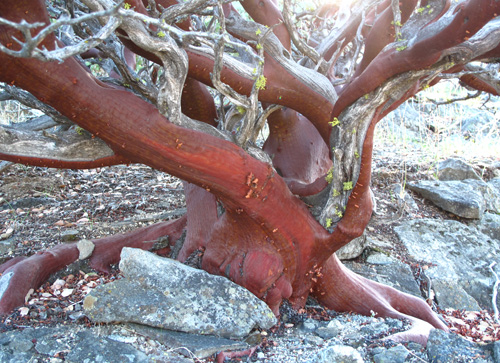
This Manzanita is growing on a granite ledge on a rise just before you drop down into Yosemite valley. The others shown below are from the same general area. All the photos were taken by Amy Palmer, during a Sierra hiking and tree identification trip that Amy and I just returned from.
Pervasive, beautiful, and seemingly perfect for bonsai
Whenever I go into the California Coast range or the Sierras, I’m struck by the Manzanitas. Not only are they eye catching in ways few plants are (the photos speak for themselves) but many appear to be near perfect for bonsai with squat trunks, small leaves and more than their fair share of character. And, they are practically everywhere. To be sure some are too big (there are over fifty species of Manzanita) but many, if not most, varieties look ready made bonsai.
Where are all the Manzanita bonsai?
My guess is that manzanitas just don’t take to bonsai culture. But, it’s just a guess. Or maybe there are some great manzanita bonsai that have been hiding from me. Perhaps one of you lucky enough to live in mazanita country can clue me in.
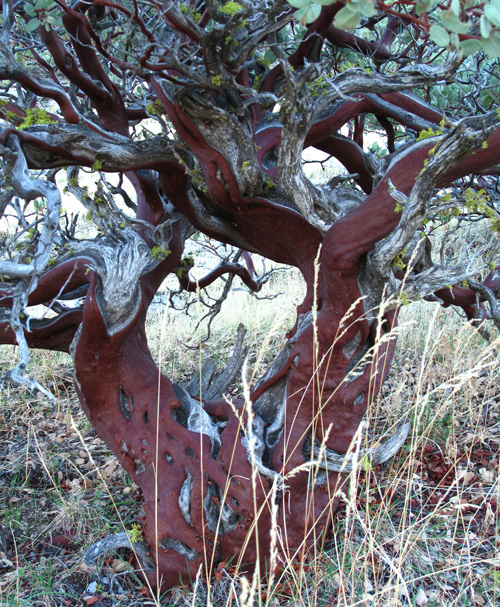
The fairly short grasses give you some idea just how squat and powerful this trunk is. No need to point out the dramatic interplay of deadwood and the trademark slick red bark.
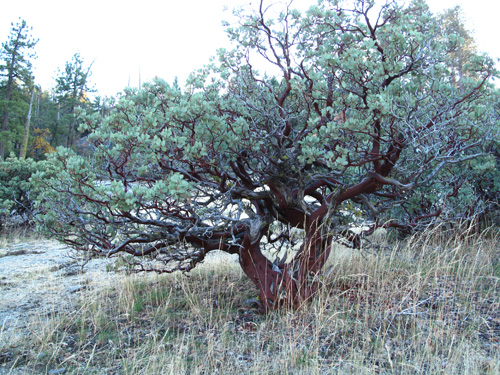
Same tree as above. It stands about five feet high.
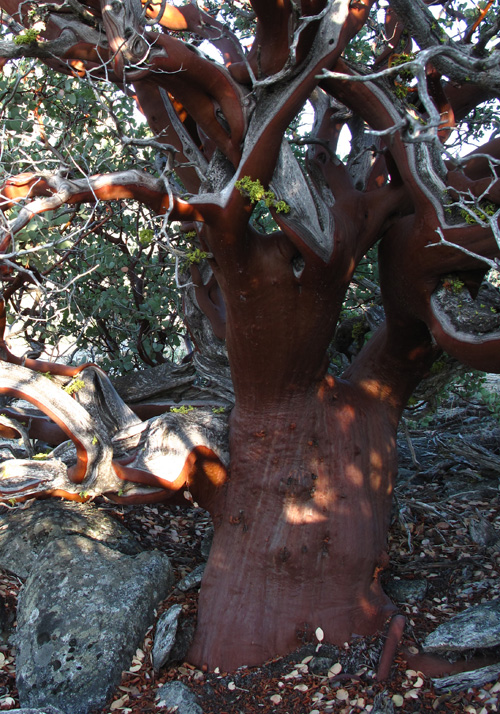
Another powerful little trunk. It looks like soil around the base of the trunk, but really it’s almost all granite. What appears to be soil is just some organic matter that has dropped off the tree or been blown around the base of the trunk by the wind.
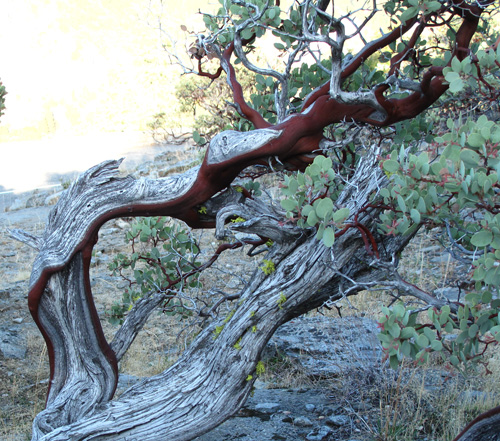
We shot this one to give you some idea of just how much deadwood an old manzanita can have. Notice the two thin live veins that support the entire tree.
Those things are gorgeous! I have never been lucky enough to see one in person, but I agree, they do look like they would make great bonsai. Looks can be deceiving though. I wonder if the beautiful bark would detract from the foliage too much…
I have successfully collected a number of different species from the wild however of the three manzanitas I have collected, all have died once potted. I gave up as I just don’t want to kill any more of these beautiful plants.
Everyone I’ve met who has successfully collected manzanita has said that they’re very hard to collect and keep alive in bonsai culture.
I have seen potted manzanita in nurseries (I think it’s Arctostaphylos uva-ursi for some reason), sold as a goundcover, so theoretically they should be adaptable to container culture. I have heard the “they die” stories too though.
In north San Diego County there’s another species of Manzanita, different genus, Xylococcus bicolor (“Mission manzanita”). Not as dramatic as those pictured in this blog, but they do have some of the same features, with leaves that look much more like olives in both color and shape. Attractive red bark, deadwood as well, but not as shimpaku-like as those pictured. I did dig a sizable, mature one one up and I transplanted it in my mother’s garden — same area, same soil (decomposed granite), and it has taken off and grown considerably. Now, that one, like most other chaparral plants, grew from a very large burl that had probably been burnt a few times over the years, and that burl probably had a lot of life in it to keep the plant vital. So it could be that Xylococcus is a viable manzanita. I wonder if any of the collected Arctostapylos had burls to sustain them?
Some of the same comments made about manzanita, by the way, are made about the madrone, another gorgeous West Coast tree with smooth, red-orange exfoliating bark. Anyone ever grow a madrone bonsai successfully?
Hi Al. Yeah, different genus but same family: Ericaceae. Apparently Manzanitas, like pines, are dependent on mycorrhizal fungi. Maybe the lack of this critical fungi explains why people are having problems with them in containers.
Your question about burls is interesting. We know that they help Manzanitas survive fires, but don’t know anything about them helping to survive life in pots.
Yeah. Madrones are beautiful too. Though larger leaves and longer internodes might be an issue with bonsai.
It is without a doubt a matter mutio good, this plant has good potential, they (Jim and chari) are a natural work of this plant, so it is very imprecionante … big hug for all good matea same …”
Manzanita are difficult for bonsai for a few reasons, the biggest being they are very sensitive to overwatering, they grow in nutrient deficient soils, love hot dry summers and are very freeze tolerant. The problem here being that when people make a manzanita bonsai they overwater, flood with nutrients and take away the natural climate regime thinking that water, nutrient rich soil, and protection from extreme climate will help its growth. I’d recommend very coarse gravel so the water is drained as soon as you water so you can just water daily and the moisture doesn’t remain with occasional fertilizer. Also allow it to get plenty of sun in the summer and just let it battle cold wet weather in the winter.
The picture you are showing is what you want to mimick, poor coarse soil, exposed to extreme temperate conditions, and little water retention.
Thanks Jake,
This pose has been up a while so I’m not sure how many people will see your comments, but I certainly appreciate them.