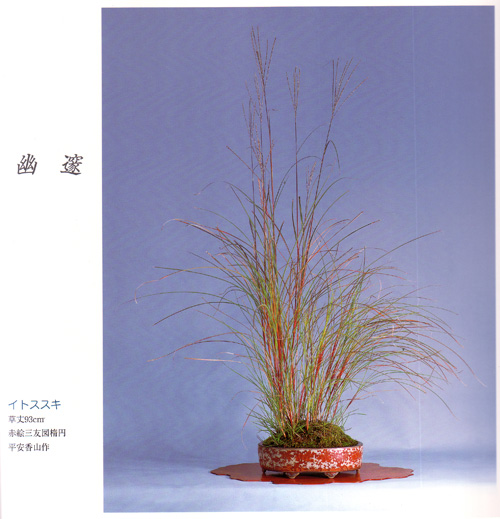
 An exquisite kusamono from our Japanese mystery book. Because I don’t read Japanese, I can’t say what the grass is (can you?), who the potter is, or even, what the name of the book is. However, I can say, with complete confidence, that the whole arrangement is beautiful.
What does Kusamono mean?
In his book Bonsai, Kusamono, Suiseki, Willi Benz says “Kusa = grass and Mono = object.” He goes on to say “If a Kusamono-Bonsai is the main object of a display, we use the term Kusamono. But if a Kusamono-Bonsai is used as an accent or complementary plant, we say it is a Shitakusa.”
Expanding the definition over time
Mr. Benz goes on to say that over time, small flowering plants have also been used as kusamono. Now many people say that any herbaceous plant in a bonsai container is a kusamono. I think this is the way most of us use the term.
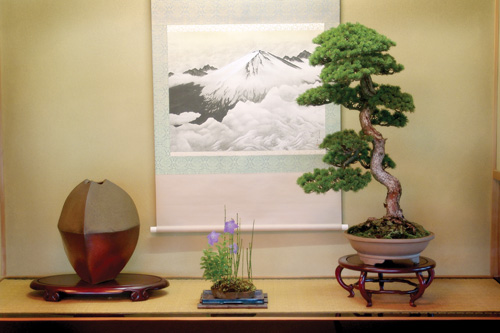
A tokonoma (display alcove) in the home of Daizo Iwasaki, that features a summer display of a bonsai, a flowering companion plant (shitakusa), a scroll and another object that looks like a large vase. The photo is by Morten Albek and appears in his book, Majesty in Miniature, Shohin Bonsai, Unlocking the Secrets of Small Trees.
Are kusamono bonsai?
Whether we call it simply a kusamono or a kusamono-bonsai (like Wille Benz), is a matter of choice, though the latter does imply that you include kusamono as bonsai. Beyond that, I’m sure the answer depends upon who you talk to.
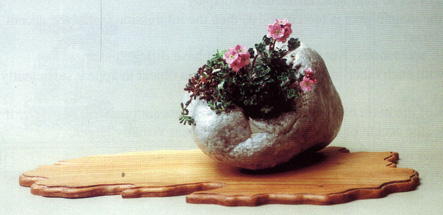 In this kusamono, a stone doubles as the pot. The stand is pearwood. The photo (cropped here) appears in Willi Benz’s, Bonsai, Kusamono, Suiseki. From the collection of Willi Benz.
I just received this message via email from Bill Valavanis. For more on Bill go to: internationalbonsai.com <http://www.internationalbonsai.com/>
“The kusamono grass looks like the dwarf Yakushima maidenhair grass. It may be the common Maidenhair grass, but I doubt it. Here is more information:”
http://hcs.osu.edu/hort/plantlisting/m/Miscanthus228.html
For those of you who don’t know him, Bill is one of the original and most accomplished American bonsai artists. Bill recently organized and the 1st US National Bonsai Exhibition, which resulted in a commemorative album <http://www.stonelantern.com/Commemorative_Album_1st_U_S_National_Bonsai_Exhi_p/b1natex.htm>, among other things. You can find it at stonelantern.com
Wayne,
Creating mostly shohin bonsai, I have naturally delved into the creation of kusamono and companion plants. I find that I drift more and more to these – they are fun to create, give a fresh, natural feeling and offer a wide variety of textures, colors and shapes. Fun!
By the way, I very much enjoy Bonsai Bark, particularly for its frequent postings and variety of topics. Good Job!!
John Romano
Thanks John. Yeah, Shohin and kusamono are a natural fit. And BTW, I see you’re teaching a lot at my old stomping grounds (New England Bonsai). Your Kaikou School of Bonsai sounds intriguing. Keep us posted.
Wayne….just curious…..do you come across suppliers’ baseball hats for some of the Japanese tools or etc.?
glad you can fit in a vacation or two….. David
Hi David,
I like the idea of Japanese baseball caps. Alas, no Japanese of Chinese suppliers has offered us any. If I get a chance I’ll check around and see what’s out there.